
How to Manage Hormone Health Naturally: An Evidence-Based Guide
What current research says about food, sleep, stress and movement, and when symptoms need a clinical evaluation.


Quick summary
Hormones respond to the basics: what you eat, how you sleep, how you handle stress and how you move. Current research supports a whole-food eating pattern with fiber and protein, at least 7 hours of sleep, regular stress-reduction practice, and muscle-strengthening exercise.1,2,3,4 These habits help, but they do not replace an evaluation when symptoms are persistent, severe or new.
- Adults who sleep less than 7 hours a night may have more health problems than those who get 7 or more.2
- Short sleep measurably lowers insulin sensitivity in controlled trials.5
- Stress-management programs, especially mindfulness and relaxation, can lower cortisol.3
- About 30 to 60 minutes a week of muscle-strengthening activity is linked to lower diabetes and mortality risk.4
- Supplements are not reviewed by the FDA for effectiveness before they are sold, so talk with a clinician first.6
How I approach hormone health: evidence-based practice
Hormones such as insulin, cortisol, thyroid hormone, estrogen and testosterone act as a communication network. They influence energy, mood, sleep, weight and reproductive health, and they influence each other. That is why a single lab value rarely tells the whole story, and why quick fixes tend to disappoint.
Everything in this guide follows evidence-based practice, the standard I use in my clinical work. Evidence-based practice means asking a clear clinical question, finding and appraising the best available research, and applying it together with clinical expertise and each patient's own values and preferences.7 It is not an academic exercise: health systems that use evidence-based practice see better patient outcomes.8 Each recommendation below is linked to a peer-reviewed study or National Institutes of Health (NIH) resource published within the last five years. The numbered references are at the end of the article.
Symptoms worth paying attention to
Hormone-related symptoms overlap heavily with other conditions, so no single symptom is a diagnosis. A cluster that lasts for weeks is worth discussing with a clinician. Common examples include:
- Energy and temperature: fatigue that sleep does not fix, feeling cold, dry skin or thinning hair. Thyroid problems often develop gradually, and symptoms vary widely from person to person.9
- Blood sugar: increased urination, feeling very thirsty, feeling very hungry even after eating, blurred vision, fatigue, or sores that heal slowly.10
- Cycle and androgen signs: irregular periods, acne or unwanted hair growth can point to polycystic ovary syndrome (PCOS), which international guidelines now recognize also carries metabolic, cardiovascular and emotional health risks.11
- Mood and sleep: persistent low mood, anxiety or insomnia.
Food: the pattern matters more than any single ingredient
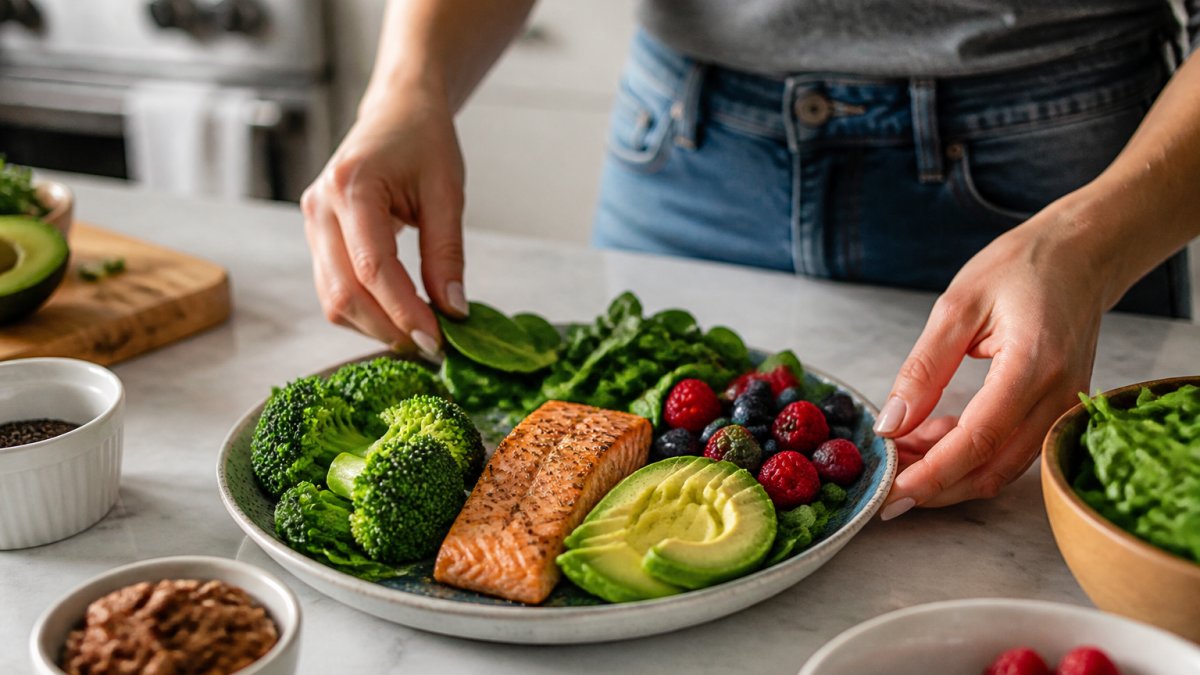
No single food balances hormones. Your overall eating pattern does the work, and the strongest evidence points to two things: more fiber and whole foods, and fewer ultra-processed foods.
Limit ultra-processed foods
A large 2024 umbrella review covering nearly 10 million people found that higher intake of ultra-processed foods is associated with higher risk of type 2 diabetes, cardiovascular death, obesity, anxiety and poor sleep.12 These are associations from observational studies, not proof of cause, but the pattern is consistent across many outcomes.
Fiber at most meals
Across meta-analyses of randomized trials, higher fiber intake lowered fasting glucose, fasting insulin, insulin resistance (HOMA-IR), HbA1c and LDL cholesterol.1 Practical sources include beans, lentils, oats, vegetables, fruit, nuts, seeds and whole grains. Increase fiber gradually and drink enough water to avoid bloating.
Protein and a better breakfast
Protein supplies amino acids and helps keep meals filling. In people with diabetes, a 2026 meta-analysis of 25 randomized trials found that changing breakfast composition improved post-meal blood sugar and HbA1c, with legume-based and low-glycemic-index breakfasts lowering 2-hour glucose the most.13 Eggs, Greek yogurt, beans, tofu, fish and poultry are practical options. Protein needs vary, so ask your clinician or a registered dietitian what target fits you.
Healthy fats
Cholesterol is the precursor of all steroid hormones, including estrogen, progesterone, testosterone and cortisol.14 Your body makes most of the cholesterol it needs, so this is not a reason to eat more cholesterol. It is a reason to choose quality fats such as olive oil, nuts, seeds, avocado and fish rather than relying on processed foods.
Cruciferous vegetables
Broccoli, kale, cauliflower, Brussels sprouts and cabbage are nutritious and high in fiber. They also contain natural plant substances such as indole-3-carbinol that researchers are studying for effects on estrogen signaling, but that work is mostly laboratory-based and has not been proven to change hormone levels in people.15 Eat them because they are good vegetables, not as a hormone treatment.
Iodine and selenium for the thyroid
Iodine is part of thyroid hormone itself. Good food sources include seafood, seaweed, eggs and dairy, and it is added to iodized salt.16 Selenium-containing proteins help the body process thyroid hormone, and seafood, meat, poultry and Brazil nuts are rich sources.17 More is not better: in susceptible people, excess iodine can cause hypothyroidism, hyperthyroidism or thyroiditis,16 and long-term high selenium intake can cause hair loss and brittle nails. The adult upper limit for selenium is 400 mcg a day.17 Food first; supplements only after a conversation with your clinician.
What a hormone-friendly day can look like
Breakfast: eggs or Greek yogurt with fruit, or a bean-based dish. Lunch: a lentil or chicken bowl with roasted broccoli and olive oil. Dinner: fish with a whole grain and leafy greens. Snack: a handful of nuts. The exact menu matters less than the structure: fiber and protein at each meal, healthy fats throughout, and minimal ultra-processed food.
Habits that work against hormone balance
Regular ultra-processed eating is linked to worse cardiometabolic health, as described above.12 Alcohol disrupts sleep: in a 2025 meta-analysis, even about two standard drinks reduced REM sleep, and the effect grew with higher doses.18 Short or irregular sleep impairs insulin sensitivity, covered next.5
One indulgent weekend won't undo your progress, and one perfect week won't fix everything. Consistency over months is what moves the needle.
Sleep
The NIH's National Heart, Lung, and Blood Institute notes that adults who sleep less than 7 hours a night may have more health issues than those who sleep 7 or more.2 In randomized trials, restricting sleep reduced insulin sensitivity, and both poor sleep timing (circadian misalignment) and reduced deep sleep had similar effects.5
What helps:
- Keep a consistent wake time, including weekends.
- Dim screens in the hour before bed.
- Keep the bedroom cool, dark and quiet.
- Limit caffeine after early afternoon and avoid alcohol close to bedtime.18
If you sleep 7 to 8 hours and still wake exhausted, or you snore heavily, raise it with a clinician. Sleep apnea is common in some hormone conditions, including PCOS.11
Stress and cortisol
Cortisol, the main stress hormone, affects blood sugar, blood pressure and sleep. A 2024 meta-analysis of 58 randomized trials found that stress-management programs lowered cortisol, with mindfulness, meditation and relaxation training showing the clearest effects.3
Short, repeatable practices beat ambitious plans you abandon:
- Daily: 10 minutes of slow breathing, a guided relaxation, or a short walk.
- Weekly: one activity that is genuinely restorative, not just productive.
- Ongoing: protect boundaries around work and sleep.
Exercise and weight
A meta-analysis of cohort studies found that muscle-strengthening activity was associated with a 10% to 17% lower risk of death, cardiovascular disease, cancer and diabetes. The largest benefit appeared at about 30 to 60 minutes a week, and combining strength work with aerobic activity was also linked to lower mortality.4 Two strength sessions a week plus regular walking is a realistic starting point.
Weight matters for hormones too. A 2026 umbrella review found that weight-loss interventions improve sex-hormone profiles in adults with obesity: testosterone and sex hormone-binding globulin rose in men, and physical activity modestly lowered estradiol in women.19 If weight and blood sugar are part of your picture, medical weight loss through telehealth can provide personalized support.
| Goal | Practical habit | Evidence |
|---|---|---|
| Steadier blood sugar | Fiber and protein at each meal | Fiber lowers glucose, insulin and HbA1c1 |
| Better insulin sensitivity | At least 7 hours of sleep | Sleep restriction reduces insulin sensitivity5 |
| Lower cortisol | Daily mindfulness or relaxation | Lowers cortisol in trials3 |
| Lower diabetes risk | Strength training 30–60 min/week | Linked to lower risk4 |
Supplements: proceed with caution
"Natural" does not mean risk-free. The FDA does not determine whether dietary supplements are effective before they are sold, and some supplements interact with medications. For example, St. John's wort can make birth control pills and some antidepressants less effective.6 Before starting anything marketed for "hormone balance":
- Talk with your clinician, and bring the bottle or a photo of the label.
- Check for interactions with medications you already take.
- Be skeptical of products promising fast hormone results.
- Avoid high-dose iodine or selenium unless a clinician recommends it.16,17
When to get evaluated, and what testing can show
Lifestyle changes are the foundation, but some patterns deserve a visit rather than another tweak:
- Periods that stop, become very heavy, or change noticeably in timing.
- Significant weight gain or loss without a change in eating or activity.
- Persistent fatigue with feeling cold, dry skin, hair thinning, or swelling at the front of the neck.9
- Increased thirst and urination, or blurred vision.10
- New acne, unwanted hair growth, or a new pattern of hair loss.11
- Low mood, anxiety or insomnia that does not improve with better sleep habits.
What testing can and can't show. Lab tests help evaluate specific conditions when interpreted alongside your symptoms and history. Thyroid function, for example, is assessed with TSH and free thyroxine (free T4), and results can fall into an in-between "subclinical" range that needs clinical judgment.9 Many hormones also vary with time of day, cycle phase, recent illness and stress, so when you test matters. A result inside the reference range can still be meaningful for you, and one outside it does not always mean disease. That is why results belong in a conversation with a clinician, not a self-diagnosis.
Before your visit, keep a short log of symptoms, dates, cycle timing, sleep and medications. Patterns are what clinicians work from.
Building your plan with Tonies Health
I'm Lucas Tonies, MSN, APRN, FNP-C, CCRN, a board-certified family nurse practitioner with 17 years of critical care nursing experience. I see patients by secure video visit in California and eight other states, in English and Spanish. My approach is evidence-based: I listen first, review your history, decide together with you whether testing makes sense, and build a plan that fits how you actually live. For men's hormone concerns, see men's health and hormone therapy; for costs, see pricing.
Book through the new patient portal
Frequently asked questions
How can I support my hormone health naturally?
Focus on an eating pattern rich in fiber and whole foods,1,12 at least 7 hours of sleep,2 a daily stress-reduction practice,3 and regular strength training.4 These habits build a foundation, and they make medical care more effective when it is needed.
What are common signs of a hormone imbalance?
Fatigue, unexplained weight change, irregular periods, sleep problems, mood changes, and changes in skin or hair are common. These overlap with many other conditions, so they do not confirm a hormone problem on their own. Persistent symptoms deserve an evaluation.9,11
Can sleep and stress really change hormone levels?
Yes. Controlled trials show that short sleep reduces insulin sensitivity,5 and stress-management programs can lower cortisol.3
Should I take a supplement to balance my hormones?
Not without talking to a clinician. Supplements are not reviewed for effectiveness before they are sold, some interact with medications,6 and excess iodine or selenium can cause harm.16,17
Can lifestyle changes replace hormone treatment?
Sometimes they are enough, and sometimes they are not. Many conditions, such as hypothyroidism, need testing and prescription treatment.9 Use lifestyle habits as the foundation and seek care when symptoms persist.
References
Sources are peer-reviewed research and National Institutes of Health (NIH) resources published within the last five years, formatted in APA 7th edition. Numbers in the text link to each source.
- Fu, L., Zhang, G., Qian, S., Zhang, Q., & Tan, M. (2022). Associations between dietary fiber intake and cardiovascular risk factors: An umbrella review of meta-analyses of randomized controlled trials. Frontiers in Nutrition, 9, Article 972399. https://doi.org/10.3389/fnut.2022.972399 PubMed (NIH): https://pubmed.ncbi.nlm.nih.gov/36172520/ ↩ ↩ ↩ ↩
- National Heart, Lung, and Blood Institute. (2022, March 24). How much sleep is enough? National Institutes of Health. https://www.nhlbi.nih.gov/health/sleep/how-much-sleep ↩ ↩ ↩ ↩
- Rogerson, O., Wilding, S., Prudenzi, A., & O’Connor, D. B. (2024). Effectiveness of stress management interventions to change cortisol levels: A systematic review and meta-analysis. Psychoneuroendocrinology, 159, Article 106415. https://doi.org/10.1016/j.psyneuen.2023.106415 PubMed (NIH): https://pubmed.ncbi.nlm.nih.gov/37879237/ ↩ ↩ ↩ ↩ ↩ ↩
- Momma, H., Kawakami, R., Honda, T., & Sawada, S. S. (2022). Muscle-strengthening activities are associated with lower risk and mortality in major non-communicable diseases: A systematic review and meta-analysis of cohort studies. British Journal of Sports Medicine, 56(13), 755–763. https://doi.org/10.1136/bjsports-2021-105061 PubMed (NIH): https://pubmed.ncbi.nlm.nih.gov/35228201/ ↩ ↩ ↩ ↩ ↩
- Sondrup, N., Termannsen, A.-D., Eriksen, J. N., Hjorth, M. F., Færch, K., Klingenberg, L., & Quist, J. S. (2022). Effects of sleep manipulation on markers of insulin sensitivity: A systematic review and meta-analysis of randomized controlled trials. Sleep Medicine Reviews, 62, Article 101594. https://doi.org/10.1016/j.smrv.2022.101594 PubMed (NIH): https://pubmed.ncbi.nlm.nih.gov/35189549/ ↩ ↩ ↩ ↩ ↩
- Office of Dietary Supplements. (2023, January 4). Dietary supplements: What you need to know. National Institutes of Health. https://ods.od.nih.gov/factsheets/WYNTK-Consumer/ ↩ ↩ ↩
- Dusin, J., Melanson, A., & Mische-Lawson, L. (2023). Evidence-based practice models and frameworks in the healthcare setting: A scoping review. BMJ Open, 13(5), Article e071188. https://doi.org/10.1136/bmjopen-2022-071188 PubMed (NIH): https://pubmed.ncbi.nlm.nih.gov/37217268/ ↩
- Connor, L., Dean, J., McNett, M., Tydings, D. M., Shrout, A., Gorsuch, P. F., Hole, A., Moore, L., Brown, R., Melnyk, B. M., & Gallagher-Ford, L. (2023). Evidence-based practice improves patient outcomes and healthcare system return on investment: Findings from a scoping review. Worldviews on Evidence-Based Nursing, 20(1), 6–15. https://doi.org/10.1111/wvn.12621 PubMed (NIH): https://pubmed.ncbi.nlm.nih.gov/36751881/ ↩
- Chaker, L., Razvi, S., Bensenor, I. M., Azizi, F., Pearce, E. N., & Peeters, R. P. (2022). Hypothyroidism. Nature Reviews Disease Primers, 8(1), Article 30. https://doi.org/10.1038/s41572-022-00357-7 PubMed (NIH): https://pubmed.ncbi.nlm.nih.gov/35589725/ ↩ ↩ ↩ ↩ ↩
- National Institute of Diabetes and Digestive and Kidney Diseases. (2024, October). Symptoms & causes of diabetes. National Institutes of Health. https://www.niddk.nih.gov/health-information/diabetes/overview/symptoms-causes ↩ ↩
- Teede, H. J., Tay, C. T., Laven, J. J. E., Dokras, A., Moran, L. J., Piltonen, T. T., Costello, M. F., Boivin, J., Redman, L. M., Boyle, J. A., Norman, R. J., Mousa, A., & Joham, A. E. (2023). Recommendations from the 2023 international evidence-based guideline for the assessment and management of polycystic ovary syndrome. European Journal of Endocrinology, 189(2), G43–G64. https://doi.org/10.1093/ejendo/lvad096 PubMed (NIH): https://pubmed.ncbi.nlm.nih.gov/37580861/ ↩ ↩ ↩ ↩
- Lane, M. M., Gamage, E., Du, S., Ashtree, D. N., McGuinness, A. J., Gauci, S., Baker, P., Lawrence, M., Rebholz, C. M., Srour, B., Touvier, M., Jacka, F. N., O’Neil, A., Segasby, T., & Marx, W. (2024). Ultra-processed food exposure and adverse health outcomes: Umbrella review of epidemiological meta-analyses. BMJ, 384, Article e077310. https://doi.org/10.1136/bmj-2023-077310 PubMed (NIH): https://pubmed.ncbi.nlm.nih.gov/38418082/ ↩ ↩ ↩
- Fang, J.-X., Huang, F., Gu, Q., Meng, J., Zou, H.-M., Han, Y., Han, Y.-X., Liu, H.-Z., Ma, Q.-W., Chen, X.-S., & Wang, S.-J. (2026). Effects of breakfast macronutrient composition on postprandial glycemic control in patients with diabetes mellitus: A systematic review and meta-analysis of randomized controlled trials. Frontiers in Endocrinology, 17, Article 1859725. https://doi.org/10.3389/fendo.2026.1859725 PubMed (NIH): https://pubmed.ncbi.nlm.nih.gov/42676343/ ↩
- Melchinger, P., & Garcia, B. M. (2023). Mitochondria are midfield players in steroid synthesis. The International Journal of Biochemistry & Cell Biology, 160, Article 106431. https://doi.org/10.1016/j.biocel.2023.106431 PubMed (NIH): https://pubmed.ncbi.nlm.nih.gov/37207805/ ↩
- Wang, M., Shi, Z., Wang, F., Wang, C., & Wang, H. (2025). Integrating structure-activity relationships, computational approaches, and experimental validation to unlock the therapeutic potential of indole-3-carbinol and its derivatives. Biochemical Pharmacology, 238, Article 116968. https://doi.org/10.1016/j.bcp.2025.116968 PubMed (NIH): https://pubmed.ncbi.nlm.nih.gov/40318812/ ↩
- Office of Dietary Supplements. (2024, November 5). Iodine: Fact sheet for health professionals. National Institutes of Health. https://ods.od.nih.gov/factsheets/Iodine-HealthProfessional/ ↩ ↩ ↩ ↩
- Office of Dietary Supplements. (2025, September 4). Selenium: Fact sheet for health professionals. National Institutes of Health. https://ods.od.nih.gov/factsheets/Selenium-HealthProfessional/ ↩ ↩ ↩ ↩
- Gardiner, C., Weakley, J., Burke, L. M., Roach, G. D., Sargent, C., Maniar, N., Huynh, M., Miller, D. J., Townshend, A., & Halson, S. L. (2025). The effect of alcohol on subsequent sleep in healthy adults: A systematic review and meta-analysis. Sleep Medicine Reviews, 80, Article 102030. https://doi.org/10.1016/j.smrv.2024.102030 PubMed (NIH): https://pubmed.ncbi.nlm.nih.gov/39631226/ ↩ ↩
- Nayak, S. S., Partheepan, K., Mantena, S., Misra, M., De Leon, G., Perali, T., Chen, J., Islam, M. A., Sedaliu, T., & Polisetty, L. (2026). The effect of weight loss and weight loss interventions on sex hormones: An umbrella review of systematic reviews and meta-analyses. Endocrine Practice, 32(2), 246–257. https://doi.org/10.1016/j.eprac.2025.10.014 PubMed (NIH): https://pubmed.ncbi.nlm.nih.gov/41167564/ ↩